Tuesday, September 10, 2013

Hollow Blocks used by SEVAI for the construction of Cost effective Housing


Shelter walls constructed by SEVAI in Trichy slums for fire victims

Cost effective Housing is an appropriate concept which deals with effective budgeting and following of techniques which help in reducing the cost construction through the use of locally available materials along with improved skills and technology without sacrificing the strength, performance and life of the structure. There is huge misconception that Cost effective Housing is suitable for only sub standard works and they are constructed by utilizing cheap building materials of low quality. The fact is that Cost effective Housing is done by proper management of resources. Economy is also achieved by postponing finishing works or implementing them in phases. The building construction cost can be divided into two parts namely: Building material cost and Labour cost. Now in Cost effective Housing, building material cost is less because we make use of the locally available materials and also the labour cost can be reduced by properly making the time schedule of our work. Cost of reduction is achieved by selection of more efficient material or by an improved design.Areas from where cost can be reduced in Cost effective Housing are Reducing plinth area by using thinner wall concept.Ex.15 cms thick solid concrete block wall, Using locally available material in an innovative form like soil cement blocks in place of burnt brick and applying  energy efficiency materials which consumes less energy like concrete block in place of burnt brick. Use environmentally friendly materials which are substitute for conventional building components like use R.C.C. Door and window frames in place of wooden frames. Preplan every component of a house and rationalize the design procedure for reducing the size of the component in the building. By planning each and every component of a house the wastage of materials due to demolition of the unplanned component of the house can be avoided. Each component of the house shall be checked whether if it’s necessary, if it is not necessary, then that component should not be used. Normally the foundation cost comes to about 10 to 15% of the total building and usually foundation depth of 3 to 4 ft. is adopted for single or double store building and also the concrete bed of 6″(15 Cms.) is used for the foundation which could be avoided. It is recommended to adopt a foundation depth of 2 ft.(0.6m) for normal soil like gravely soil, red soils etc., and use the uncoursed rubble masonry with the bond stones and good packing. Similarly the foundation width is rationalized to 2 ft.(0.6m).To avoid cracks formation in foundation the masonry shall be thoroughly packed with cement mortar of 1:8 boulders and bond stones at regular intervals.It is further suggested adopt arch foundation in ordinary soil for effecting reduction in construction cost up to 40%.This kind of foundation will help in bridging the loose pockets of soil which occurs along the foundation. In the case black cotton and other soft soils it is recommend to use under ream pile foundation which saves about 20 to 25% in cost over the conventional method of construction. It is suggested to adopt 1 ft. height above ground level for the plinth and may be constructed with a cement mortar of 1:6. The plinth slab of 4 to 6″ which is normally adopted can be avoided and in its place brick on edge can be used for reducing the cost. By adopting this procedure the cost of plinth foundation can be reduced by about 35 to 50%.It is necessary to take precaution of providing impervious blanket like concrete slabs or stone slabs all round the building for enabling to reduce erosion of soil and thereby avoiding exposure of foundation surface and crack formation. Wall thickness of 6 to 9″ is recommended for adoption in the construction of walls all-round the building and 41/2 ” for inside walls.The above suggestions for reducing construction cost is of general nature and it varies depending upon the nature of the building to be constructed, budget of the owner, geographical location where the house is to be constructed, availability of the building material, good construction management practices etc..Govin

“Banana Planters has a strict policy of not using harmful chemical in the production process”. K.Devendran, SEVAI.


Banana plantation in Amoor by SEVAI

“Banana Planters has a strict policy of not using harmful chemical in the production process” said by K.Devendran, Coordinator of SEVAI, Agriculture project.K.Devendran was involved in farm training of Banana growers in SEVAI,Amoor and further said,  Growing bananas does not require much effort but to achieve high yields requires skills, dedication, and proper planting methods. Bananas need warm subtropical climate, adequate moisture and protection from wind. The ideal temperature range is around 26-30°C. Although Bananas grow best in bright sunlight, high temperature will scorch leaves and fruit. High velocity wind which exceeds 80km per hour damages the leaf. Bananas are also vulnerable to being blown over due to the weight of the stem of fruit. Thus, Propping should be done during the last few months of its life cycle before harvest. Bananas need rich, moisture and well-drained soil with 40% clay, 75% silt, 85% loam. Bananas prefer a more acidic soil with pH between 6-7.5. Avoid soil that is sandy, salty, nutritionally deficient and ill-drained soil. Bananas do not tolerate water logging because its roots will rot. Bananas need nitrogen, phosphorus, and potassium with a ratio of 3:1:6 and other micronutrients to ensure the plants grow vigorously. The most economical and efficient spacing is 1.82m x 1.52m with 3,630 plants per hectare (a wide spacing of 1.82 m between rows). Depending on the soil quality, one must apply the appropriate method as well as the depth and spacing at which plants are required to be planted. Mark the spots where the plants will be planted. Avoid marking and planting as you go because any oversight may lead to uneven spread of the Bananas. The best method to avoid this from happening is to use a long measuring tape. Dig a hole with a foot in diameter and ten to twelve inches deep and place the plants in the hole keeping the pseudo-stem 1 inch below the ground level. Toss a small amount of fertilizer into the hole to boost the growth of the plant and fill the hole with soil. Soil around the plant should be tramped down firmly to remove air pockets. A complete fertiliser with a ratio of 3:1:6 of nitrogen, phosphorus, potassium is generally suitable for most Banana plantation. It is advisable to water and fertilize at the same time to help Bananas grow. If water system is not available, the best time for application of fertilizer is after rain. Mulch is primarily used to modify the effects of the local climate. A wide variety of natural and synthetic materials are used. Support Banana plants with bamboos. Banana plants often go off balance due to the heavy weight of the bunch. Therefore, two bamboos should be propped by placing one against the top of the bunch and the other against the stem on the leaning side. Propping using only one bamboo is not advisable as the Banana plant may plunge to the other direction during strong wind. Harvest when fingers are fairly evenly rounded. General practice is to harvest when fingers of second hand are ¾ rounded. The mother plant should be cut off after harvest as the plant can never produce again”. Govin

Saturday, September 7, 2013

Agriculture field waterway needs to be cleared by farmers’ civil society.


Water body to agriculture field obstructed by water plants

We are thankful to nature and we have water in River Cauvery and paddy cultivation is progressing in Pettavaithalai. We faced extreme drought during 2012 as there is no rain and there was also no water in River Cauvery. Due to the good South west monsoon, the Mettur dam Reservoir touched its full capacity and water in River Cauvery was released for Agriculture operation by Government of Tamilnadu. Although the water is full in River Cauvery, the branch water ways to the agriculture field is surrounded by water blocking plants. These plants need to be cleared for the smooth flow of water in waterways to Agriculture fields in Pettavaithalai and Sirugamani.We cannot expect that all these works are to be attended by Governments. We had earlier Kudimaramathu (self help by community) and this system is slowly forgotten, and the public think that all minor activities are to be implemented by Governments. It is important that the local civil societies are to recollect the Kudimaramathu and clear the buses and water blocking plants in waterway to the agriculture field. Such initiatives are to be undertaken by Gramasaba members and they can apply to Government to get permission to clear the bushes at Farmers cost instead of waiting for the Government to clear these water body bushes. As a farmer of this feeding waterway to my agriculture filed, I am most willing to contribute my share of expenditure to clear the blocks and get smooth water flow to my paddy field.-Govin

“Periodic monitoring serves the purpose of making Cow project more visible and successful”. - SEVAI.


SEVAI-OFI Volunteers cow project -Sirugamani

SEVAI Team undertakes monitors efficient management of Cow project in SEVAI Sirugamani as guided/supported by OFI Volunteers. This management system to monitor all activities related to the Purchase of the Cows effectively in SEVAI and the team promoted Standardization of report formats from all cows, Better services, Better fund management, Effective monitoring of the cow project, compilation of all reports originating from the cow profile, travel expenses at start of cow market visits, Purchase details of Cows Seller details, etc. Insurance Details, Post purchase follow-up, Inspection details, Insurance Claim details. The system facilitates monitoring and generation of required MIS reports, providing instant access to all the documents, cow farm  Status, marketing status, staff details, Development completed. Veterinarians’ services, The SEVAI Supervisor team also verifies the feed purchased, used and the balance
SEVAI Team verifies cattle feed flow chart
stock etc. Milk sold, payments received and paid for the various approved items.Dravida Selvi and the other staff members were oriented on MIS by
Feeding calves in SEVAI-OFI Cow farm
Suda, the finance officer of SEVAI and Kalpana for Computerized documentation. SEVAI
NGO focusing on Cows rearing and also involved in fodder cultivation, feed procurement, promotion of milk cooperative, agro resource management for cow farming, water supply  and organic farming promotes sustainable livelihoods for farmers through cow rearing.SEVAI  has integrated many forms of monitoring in the implementation of the project, so that they are inseparably interwoven. Observing and recording of data of one activity is a necessary precondition for the implementation of another activity, and they are all indispensable and sensible for the ultimate aims of the Cow Project. Indicators – the data that is observed and recorded – provide necessary information for the process, but are also a source of information on the project’s influence on how this project would improve the lives of poor through using the project. M and E exercise is as a way to make the activities of the project transparent and easy to account for the Cow project. Suda mentioned, “Monitoring serves the purpose of making what we do visible in the sense that it provides tools and instruments to communicate throughout the implementation of the project”.-Govin

Wednesday, September 4, 2013

Goat rearing is viable economic activity for economically poor-SEVAI Coordinator

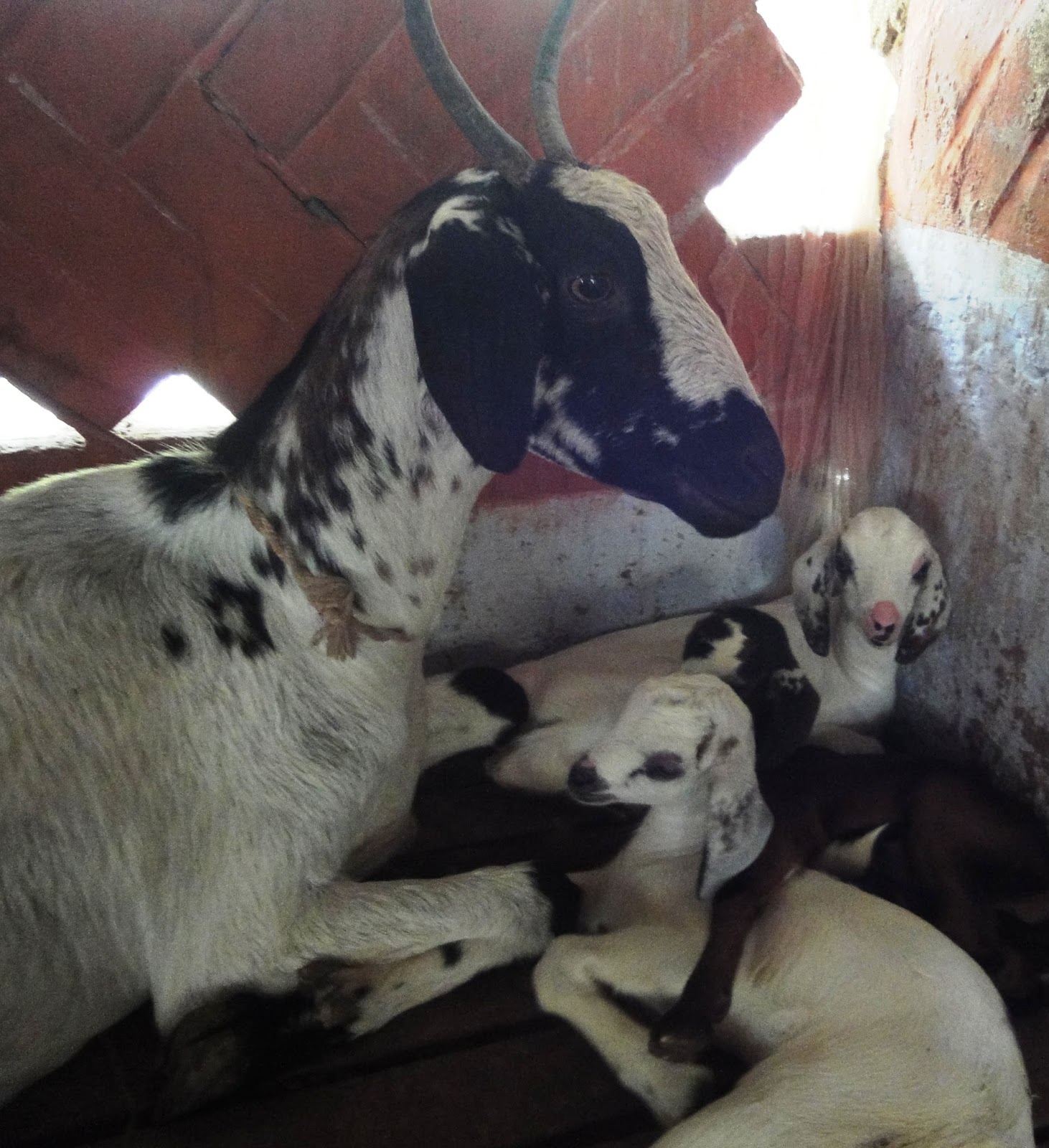
Goats in SEVAI Farm,Sirugamani

"Goat is a multi functional animal and plays a significant role in the economy and nutrition of landless, small and marginal farmers: said P.Vanitha coordinator of Women SHGs in SEVAI Goat farm. P.Vanitha further added,"Goat rearing is an enterprise which has been practiced by a large section of population in rural areas. Goats can efficiently survive on available shrubs and trees in adverse harsh environment in low fertility lands where no other crop can be grown. In pastoral and agricultural subsistence societies in India, goats are kept as a source of additional income and as an insurance against disaster.  In addition to this, goat has religious and ritualistic importance in many societies. The advantages of goat rearing are: The initial investment needed for Goat farming is low. Due to small body size and docile nature, housing requirements and manage mental problems with goats are less. Goats are friendly animals and enjoy being with the people. Goats are prolific breeders and achieve sexual maturity at the age of 10-12 months gestation period in goats is short and at the age of 16-17 months it starts giving milk. Twinning is very common and triplets and quadruplets are rare. In drought prone areas risk of goat farming is very much less as compared to other livestock species. Unlike large animals in commercial farm conditions both male and female goats have equal value. Goats are ideal for mixed species grazing. The animal can thrive well on wide variety of thorny bushes, weeds, crop residues, agricultural by-products unsuitable for human consumption. Under proper management, goats can improve and maintain grazing land and reduce bush encroachment without causing harm to the environment. No religious taboo against goat slaughter and meat consumption prevalent in the country. Slaughter and dressing operation and meat disposal can be carried without much environmental problems. The goat meat is leaner and relatively good for people who prefer low energy diet. Goat milk is said to play a role in improving appetite and digestive efficiency. Goat milk is non allergic as compared to cow milk and it has anti-fungal and anti bacterial properties and can be used for treating urogenital diseases of fungal origin. Goats are 2.5 times more economical than sheep on free range grazing under semi arid conditions. Goat creates employment to the rural poor besides effectively utilizing unpaid family labor. There is ample scope for establishing cottage industries based on goat meat and milk products and value addition to skin and fiber. Goat is termed as walking refrigerator for the storage of milk and can be milked number of times in a day."-Govin

Tuesday, September 3, 2013

SEVAI conducts training in goat rearing for goat farmers


A Goat with three kids in SEVAI Goat farm
A training manual on goat rearing is used by SEVAI for the effective training on goat rearing. This training manual on goat rearing is based on the experiences of goat farm being maintained by SEVAI in Sirugamani Village. The barefoot vetinarian takes care of the goats. The Training manual enlightens that the goat is a multi-purpose animal producing meat, milk, hide, fibre and manure. Goats have very few demands of housing and management. They hardly need separate housing and happily share their homes with their owners or his other livestock. Goats can be raised by landless agricultural labourers, ladies and children because they can thrive well on variety of leaves, shrubs, bushes, kitchen waste etc. Goat farming can be a profitable occupation for a farmer and can fit well into mixed farming. Goats are cheaper to maintain, easily available and have a friendly disposition. Goats are capable of adapting to various agro-climatic conditions ranging from arid dry to cold arid to hot humid. They can be raised in plains, hilly tracts, sandy zones and at high altitudes. Goats are more tolerant to hot climate than other farm animals. Goats suffer from fewer ailments than other large animals. Goats have got increased digestibility of crude fibre and can produce even on poor quality roughages. Goats give more production per unit of investment.   Goats are smaller in size and have a younger slaughter age. Goat meat hasno religious taboo and is relished by all sections
SEVAI Goat farm
of society. Goat meat has less fat and is more in demand. Goats are called the foster mother of man, as their milk is considered better for human nutrition than other species of livestock. Goat milk is cheap, wholesome, easily digestible and nutritious. Goat milk is finer than cow milk i.e. the fats and proteins are present in a finer state and are more easily digestible, especially by children and invalids. Goat milk has lesser allergic problems than other species of livestock. Goat milk is used as a ayurvedic medicine for personas ailing with asthma, cough, diabetes etc.. Goat milk has higher buffering qualities and this enhances its value for patients suffering from peptic ulcers, liver dysfunction, jaundice, biliary disorders and other digestive problems. Goat milk has higher phosphate content, which is beneficial for vegetarian communities. Goat milk has a higher content of B-complex vitamins.   Goat milk is suitable for preparing various milk products. Goats can be milked as often as required, preventing milk storage problems and refrigeration costs. Goat hide is used for the manufacture of leather products. Goat hairs are used for the manufacture of rugs and ropes.Goats form an excellent animal for physiological and biomedical research. Poor man’s cow: Goat has been described as a poor man’s cow (or mini-cow) because of its immense contribution to the poor man’s economy. They not only supply nutritious and easily digestible milk to their children but also regular source of additional income for poor and landless or marginal farmers. Being small-sized animals, goats can easily be managed by women and children. Feeding, milking and care of goats does not require much equipment and hard work. Capital investment and feeding costs are also quite low. Four goats can be maintained as cheaply as one indigenous cow. Goats can be successfully reared in areas where fodder resources are limited and milch cattle do not thrive. Returns on capital of up to 50% and recovery of 70% of retail price are possible in goat farming. In rural areas, goat farming plays a vital role in providing gainful employment. The goat project commenced in April, 2013 with 30 goats in SEVAI, and shortly after a few months, Several farmers have successfully run stall-fed goat farms, and they have found that such an integrated farming venture was more productive and profitable as well.Goat farming needs less capital when compared with dairying, and the animals can be raised in small farms. The floor space requirement per adult animal is about one square metre. Stall-fed goat farming is an ideal occupation for the small, marginal and landless agricultural labourers. The she-goat will deliver 2-3 kids at each parturition after a short gestation period of 150 days.-Govin

SEVAI Shelter project is not a hand-out but a “hand-up” program


Shelters constructed for tsunami Victims families by SEVAI

SEVAI Shelter is not a hand-out but a “hand-up” program. In the village building programme, we select the poor, small and remote villages which are interested in development in all aspects with the help of SEVAI. House construction costs skyrocketed making building construction almost unaffordable to the masses. The energy crisis followed adding to the problem. During later half of 20th Century, there was also greater awareness about the environmental damage due to material manufacturing processes, construction for the homeless and those affected by catastrophe like cyclone, floods since 1976. SEVAI has trained over 600 masons over the years. SEVAI has the capacity of mobilizing the areas of masonry, carpentry, barbendry, house wiring, plumbers and building multi mechanics. The shelter delivery system works through two Building Material Services Banks. The two main products building
trees planted in newly constructed homes

cement Blocks and window frames will be locally produced. These materials can be chosen because they were both cost planning steps will be implemented to ensure that the end product would really target the design workshop with the village the core houses and secondly, a process will be included a list of the villages, other putting the list reconstruction cross-check. The house takes into environmentally unsound SEVAI has been working in the field of house 500 construction skilled workers a day for masonry in material production centres, producing material cost-efficient and could be produced locally. Two crucial poorest. Firstly, a will be held together communities to design with the beneficiaries step by step screening introduced. This all damaged houses in cross-checking with programmes and to the village committees for a final design of the core consideration speed of ornamentally houses beneficiaries, to offer appropriate solutions under the community/NGO-based approach able to respond quicker, it was also more targeted and offered less costly solutions.Govin

Monday, September 2, 2013

Tree thieves are to be counseled by Civil Society


Thieves cut the trees and taken away  in Dasilnaickanoor

Dasilnaickanoor village community had planted and grown around 750 trees in 35 acres of dry land watershed area in Dasilnaickanoor of Karur District of Tamilnadu. The trees were planted in the land given by a local NGO. For the past two decades, optimum care of was given for growing trees and the variety of trees such as fruit trees, shadow trees, timber trees and soil and water conservation trees. Planting trees isn't as simple as just digging a hole and throwing the tree in it. The Civil Society wanted the trees they have planted to survive and thrive and the trees were well grown for around two decades. This has become an Afforestation project as there was no forest or stand of trees in this area prior to this tree plantation. This tree plantation program is the reestablishment of forest cover, naturally by natural seeding, coppice, or root suckers and also artificially by direct seeding
and planting. The contour bunding,gully plugging,cantour trenches, check dams
view of the trees plantation before the theft
 constructed,conjective use of water for trees growing helped this Dasilnaickanoor watershed area conserved water and soil creating Bio-diversity. During the third week of August 2013, a few wood cutting thieves cut these trees illegally and removed them from this forest owned by the Civil Society. The Civil Society Team was shocked to witness the empty land after tree feeling and steeling of the trees. The Civil Society team requested the local PRI to find the culprits, who are merciless tree fellers and proposed to catch and hand over them to Police for legal action. The Cil Society  leader Madha Naickar mentioned that they would spot the culprits and they should be given counseling and also punished through legal action so that no further damage for the trees grown for the green coverage in this dry land region.-Govin