

Thursday, April 14, 2011
SEVAI SUMMER CAMP FOR YOUTH LAUNCHED-2011

Pottery is a Profitable Business for Amour Artisans

With the revolution in information technology the whole world has become a global village. People have their reach to every corner of the world. It has threatened the existence of the natural existence of the rural people. Scientific inventions have made some people jobless too. India has been badly affected by it. The potters used to make earthen utensils. But in the modern time they too have almost lost their jobs. Thanks for Self Help Groups promoted by SEVAI and the members are abled to retain their pottery jobs even to-day. In the summer season everyone likes to drink cold water. The earthen wares were being used to cool the water for centuries. The practice of keeping water in pitchers has almost disappeared in cities and in some of the villages people still use the earthen utensils in their daily life. It is believed that the water, chilled in the pitters, is always good for the health. Pottery is considered as small business with less investment and it is considered as house hold activity for income generation. Small businesses create most of the jobs in rural India. Since the 'Great Recession' began in December 2007, several hundreds of people are involved in small business in the so called computer world and Pottery has its renewal in rural Amour village near Trichy of Tamilnadu. Pottery is a profitable business for Amour artisans and it is a form of rural technology, where wet clays are shaped and dried, then fired to harden them and make them waterproof. The terms "pottery," "earthenware" is generally used only for relatively easily constructed utensils such as pots, cups, bowls, etc., and for some decorative items. Pottery is both an ancient and modern technology, in that it uses materials and techniques that are thousands of years old but also takes advantage of more modern innovations. A person who makes pottery is generally known as a potter. The potter's most basic tool is the potter's wheel. There are basic categories of forming techniques used in pottery – handwork and wheelwork. It's very common for wheel worked pieces to be finished by handwork techniques. Handwork methods are the most primitive and individual techniques,. No two pieces of handwork will be exactly the same, so it is not suitable for making precisely matched sets of items. Doing handwork enables the potter to use their imagination to create one-of-a-kind works of art. The potter's wheel can be used for mass production, although often it is employed to make individual pieces. A ball of clay is placed in the center of a turntable, called the wheel head, which is turned chiefly using foot power (a kick wheel or treadle wheel). Oftentimes a disk of, wood is affixed to the wheel head and the ball of clay attached to the disk rather than the wheel head so as to facilitate easy removal of the finished piece. This disk is referred to as a bat. The wheel revolves rapidly while the clay is pressed, squeezed and pulled gently into shape. The process of pressuring the clay into a radial symmetry, so that it does not move from side to side as the wheel head rotates is referred to as "centering" the clay - usually the most difficult skill to master for beginning potters. Wheel work takes a lot of technical ability, but a skilled potter can produce many virtually identical plates, vases or bowls in a day. Because of its nature, wheel work can only be used to initially create items with radial symmetry on a vertical axis. These pieces can then be altered by impressing, bulging, carving, fluting, faceting, incising, and other methods to make them more visually interesting. Often, thrown pieces are further modified by having handles, lids, feet, spouts, and other functional aspects added using the techniques of handworking. Pottery that is thrown on the wheel is often finished in a process known as trimming. The thrown piece is first allowed to dry to the leather-hard state then it is returned to the potter's wheel, usually with the rim down. The piece must be re-centered to allow trimming of the foot of the pot to create a smooth and well-defined surface. There are two related techniques that improve repeatability of wheelwork. A jigger is a mould that is slowly brought down onto the outside of an object, whilst it is being turned on a wheel. A solid mould is used to form the inside of the piece. Similarly, a Wood firing is a type of firing which involves using wood, rather than gas or electricity as in most modern kilns, to heat the kiln's interior. It is frequently time-consuming, as the kiln must be stoked for as long as a few days, but the pieces which emerge often have characteristic patches of orange color on the clay itself, known as "blushing". Production stages are all pottery items go through a series of stages during construction, the raw clay is wedged to make its moisture and other particle distribution homogeneous and to remove air bubbles.

It is then shaped either by hand or using tools such as a potter's wheel, an extruder, or a slab roller. Water is used to keep the clay flexible during construction and to keep it from cracking. Work that is thrown on the wheel often needs to be trimmed or turned to make its thickness uniform and/or to form a foot on the piece. This process is done when the piece has stiffened enough to survive manipulation. This condition is called leather hard. The piece is allowed to air dry until it is hard and dry to the touch. The greenware is often given a preliminary lower range firing in a kiln. Once it has been fired, the clay is known as 'biscuit' ware or bisque. This is decorated with glaze and then fired again to a higher temperature. Some pieces are not bisque-fired before being glazed. These pieces are called once-fired. Pottery as a business is classified as an industry based on its purpose. There are a variety of ways people make money from potting. Some sell their product locally, at trade shows and weekly markets. Others sell original patterns or kits they have designed themselves. The potters of Amour have not lost their interest in their ancestral occupation and even take a lot of interest in it. There are significant numbers of people who still make pottery items. The occupation of making earthen vessels is once more gaining. In older times they used to get clay and dung very easily. Clay is used for making vessels while dung is used to bake them. But now investment costs have increased a lot. The clay is brought from the some faraway places and then they have to transport their products. The Self Help groups of Amour area both men and women are renewing their business and earn around Rs.150 per day and it works as the household income generation activity for families of Self help group members and it is important that the youth should also learn the skills with value added process. They get around 30 per cent profit from their productions. The rural sector people still prefer the pitchers. In rural sector people get the electricity supply has become a problem and in such conditions the refrigerators and water coolers have become useless boxes. It is good that Self Help Groups are able to keep their ‘centuries old’ occupation alive and this occupation should not disappear. -Govin
Sunday, April 10, 2011
‘Continuing Education is a lifelong process’-Dr.K.Govindaraju

Dr.K.Govindaraju,Chairman,South Zone Board of Continuing Education, while inaugurating a workshop on Adult and continuing Education its Trichy premises on Saturday said that Adult and continuing Education is a lifelong process He further added “The achievements of various villages in the spheres of Adult and female Education and literacy and other social development facets show that social development indicators like life expectancy and infant mortality are closely linked to the level of female literacy-the higher the female literacy rate, the lower is the infant mortality rate and the higher the life expectancy. The villages which had achieved a high level of social development had a lesser gender disparity in the spheres of education and health. The target villages of PVF under this project have performed reasonably well in terms of literacy growth during the three years duration. The target villages literacy rate increased from 62.66 per to 73.47 per cent. The female literacy rate increased from 51.33 per cent to 72.55 per cent, while the male literacy rate grew at a slower pace. With female literacy has grown more rapidly; what emerges overall is that the trend of decline in population growth is now widely spread among practically all villages of this region. The gender gap in literacy has also come down. The mass literacy campaigns of this project - have no doubt played a significant part in this progress, their contribution lay not only in their direct achievements in making people - especially women.SEVAI has been implementing two important strategies of “opening up to the outside village” and “focusing on economic construction”. SEVAI realized by implementing the project that “Adult education is an important part of the whole educational cause. In the whole educational cause, adult education enjoys the same importance as basic education, vocational and technical education and regular higher education.” “A lifelong education system has been established and improved step by step.” All these provisions have guaranteed the legitimate position of adult education and promoted the development of adult education through Distance Education mode promoted by SEVAI with the collaboration of Universities in Tamilnadu. The fundamental aim of adult education was to enable all village people with the ability to live, work and labor to realize all-round development through developing their personal resources, improving their knowledge and skills and optimizing their personality in accordance with different needs in life, work and learning. Adult education targets all villagers and SEVAI promoted the idea of lifelong learning and provide educational facilities to meet the needs of adult learners, help them utilize various learning resources and create an ideal social environment for lifelong learning. Specifically, adult education under this three year PVF Project fulfilled the following tasks provided remedial basic education to 412 young women who have failed to complete basic education and secondary education; offered pre-employment training to 324 according to employment needs to help those looking for jobs to meet standards of ideological development, moral cultivation, cultural knowledge, vocational skills and practical ability for the entire illiterate population identified among Self help group members in 13 Panchayat level Federations in the target area; offered continuous education to 105 animators specialist professional personnel to help them adapt themselves to rapid social progress and technological development; provided varieties of socio-cultural and life education to all animators and representatives to satisfy their increasing individuals’ needs for personal development and assist individuals and social groups to seize personal and social opportunities for overcoming future challenges. Under this project, adult education as a whole, it plays an important role in the establishment of the lifelong education system and the formation of a learning-based society target villages. On-the-job training and continuous education have effectively improved the skills of self help group women under this project. Preliminary achievements have been made in the experiment of constructing a lifelong education system and building a learning-based society. Great achievements have been made in the development of adult education in Trichy District. Today, along with the profound changes in various fields of social life in the new century, the development of adult education is confronted with both opportunities and challenges. In a learning-based society in the 21st century, one must be able to learn before being able to be’.
The chairman further said “However, many people today are still shackled by the traditional idea of just-for-once education and they are lacking in the concept and action of lifelong learning. In the 21st century, all citizens in various social sectors are required to bring into full play their creativity and ability and take an active part in social progress. But, society today cannot provide women with enough opportunity to receive adult education. Globalization and technical innovations in the 21st century are increasingly influencing individuals’ lives and social activities, and citizens’ career changes are becoming closely connected with adult learning. In this sense, the content of adult education must be expanded to the whole life of all citizens and linked up with the renewal and improvement of citizens’ vocational skills and ideas. As far as adult education is concerned, the lack of due emphasis by the whole of society on adult education, of an efficient management system and operation mechanism, of the integration of adult education with economic and social progress, of enough financial investment in adult education and of new teaching content and methods will restrict the full play of adult education’s role in the construction of a learning-based society. We have obtained inspiring achievements in the development of adult education, and the challenges are also opportunities. Therefore, we must make bolder efforts to realize the important role of adult education in the establishment of the lifelong education system and a learning-based society and in the promotion of women’ all-round development’.Govin
‘Freebies announcement of political parties creates doubt as it does not have inclusive approach of Development’, –a SHG member, Villuthuhal

Photo: A SHG woman, Bakiyalakshimi in Srirangam constituency expressed her happiness for receiving welfare packages from the ruling Government for the past years but the’ ‘Freebies announcements again and again creates doubt in their mind for its reach as it does not inclusive component of Welfare and Development.
Trichy, 10, April: Bakiyalakshimi said that the colour televeion,gas stoves are not simple freebies but it has integration with long term development projects for the quality of life of improvement of poor and down trodden especially the women SHG members. It is time to gain dignity to strengthen SHG Movement as fifth estate of India as visualized by Deputy Chief Minister, M.K.Statlin. It is okay to receive freebies at times of crisis and SHGs cannot digest the sheer freebies promises of AIADMK party cannot develop the women SHGs, instead of Business to Self Help Groups as inclusive component of development process, implemented by the ruling DMK. ‘Freebies announcement of opposition parties create anguish among SHGs, as SHGs believe that development is not providing but promoting the poor’-Self Help Groups did not take pleasure in the move of political parties to influence voters with freebies, development experts strongly express their dismay about the strategy adopted by political parties to tempt voters by offering freebies as gift for votes. Most Federations of Self Help Groups opined that the freebies promised and already given is additional burden for citizens and they need to pay tax in different form for the fresh freebies assured/already given by both the ruling and opposition parties. The elite Self Help Groups come to realize their own difficulties in the development of their community and try to solve them by collective participation following an order of priority and taking their potentiality into account. It is well known to you all that recognizing one's problems and striving hard to challenge them is a mark of an attempt at self-sufficiency. Self help in the benefits to be acquired through education will save the individual from expecting freebies. Let us work out our own programmes in all fields - political, economic, social and military. Man's contributions which live to influence the life and progress of posterity are the most permanent monuments that can ever be created. It is raining promises of freebies in Tamil Nadu polls. AIADMK chief J. Jayalalithaa Thursday exceeded her arch rival DMK's promises to the voters in a bid to win the April 13 assembly polls. Jayalalithaa has promised freebies ranging from free laptops to students, fans, grinders, mixies, rice, housing plot, cash assistance for students, free water and many other things, outdoing the DMK. Her promises were released while filing her nomination papers for election. To attract women voters, Jayalalithaa promised a free fan, grinder and mixie. She said her government would increase the maternity leave to six months and give a cash allowance of Rs.12,000. She also promised increase in loan assistance for self-help groups to Rs.10 lakh, of which Rs.250,000 will be a subsidy. The AIADMK boss also promised half a sovereign gold for 'mangalsutra' for poor women getting married, and for women who have completed diploma education the marriage assistance will be increased to Rs.50,000. Jayalalithaa said her government would build a green house on three cent land to below-poverty-line (BPL) families at an outlay of Rs.180,000 per house. She also promised extension of the scheme for the four million strong middle class with a subsidy of Rs.100,000. She also promised 20 kg free rice monthly and 20 litres of water daily. The DMK has promised 35 kg free rice monthly. For those who do not own land, Jayalalithaa promised allotment of three cents land for construction of house, and some action in favour of those who have borrowed housing loan from cooperative societies. SHGs did not believe in promoting freebies to garner votes "disapproved and discouraged this practice and parties should not underestimate voters" by trying to woo them with a long list of freebies. Many have-nots continue so, because they accept freebies not challenges. The voters who place his/her own short-range ambitions ahead of the long-range interests of the self help development approach have embarked on a course which will ultimately result in the dissolution of the self help development itself. It is by the understanding of past difficulties that we can bequeath fundamental guidance which would be of pride to the coming generations we therefore urge our people to struggle and to make sacrifices for those things which will enable them to ameliorate their conditions of life and leave a richer heritage. The fundamental purpose of a community development movement is to teach the rural people of Our Empire that through cooperative self-help and a united approach to common problems, the vast potential for their own self-improvement which they themselves represent, can be translated into effective programmes which can do much to improve their standard of living. Where enterprise and initiative are not lacking, the pace at which the growth of a country's economy normally proceeds can be quickened or slackened by global developments far or near. In our effort to raise the living Standard of our beloved people, in our endeavour to bring prosperity to our country, the feeling of cooperation and understanding has always characterized our people. A special case is the recent development through Self Help Groups where the people are seen voluntarily raising funds to build schools, clinics, roads and similar other projects under self help approach (Namakku Na mea). What can give one more pleasure than to see such a measure of self-help in one's life time, for the prosperity and progress of her own community? One should realize that thriftiness is the basis for the accumulation of wealth and the economic growth of a nation. One seldom minimizes the value of money earned by the sweat of the brow however small it may be, but for the extravagant even a huge amount of money is worthless.

The same SHG woman expresses her anguish and dismay for the repeated assurances of too many freebies by political parties for 2011.How come SHG movement flourish?.photo
The Self Help Group movement has long been known, and we our self have on numerous occasions urged our people to join increasingly in self Help group enterprises. Self HELP Groups play a highly important role in the growth of our economy, and no time can be lost in availing ourselves of the benefits to be derived from them for Community Development. The fundamental purpose of a community development movement is to teach the rural people that through self-help and a united approach to common problems, the vast potential for their own self-improvement which they themselves represent, can be translated into effective programmes which can do much to improve their standard of living. Lasting progress can only be built on deep and enduring foundations. When a solid foundation is laid, if the mason is able and his materials good, a strong house can be built. To develop oneself, one has to develop one's own initiative and perseverance - a man has to strive in order to grow. She respects the Prime Minister Manmohan Singh’s view expressed on Saturday in Coimbatore reposing his faith in the wisdom of the people of Tamil Nadu – that they would vote the alliance, led by the Dravida Munnetra Kazhagam (DMK), to power in the April 13 Assembly elections and will not be misled by “false” promises from the rival camp and his statement that many far-sighted schemes implemented by the government headed by Chief Minister M. Karunanidhi had turned Tamil Nadu into a model State in many ways, especially in rural development and agrarian transformation.Dr.Singh said “Recently, I saw a report by a group of economists that ranked Tamil Nadu as the number one State of India.. My Government in New Delhi has greatly benefited from the cooperation extended by our allies in Tamil Nadu. We in the Congress party are proud that leaders from Tamil Nadu are taking our country forward.”She is highly impressed about the expression of Prime Minister of India “Our government is committed to improving the status of women. Such schemes have now become universal. Tamil Nadu is in a sound financial state with strong fiscal position than most other State governments,”-EtNS.
Friday, April 8, 2011
World Health day-2011- Hand-washing/ LWS tips -SEVAI

Trichy, 8, April: The theme of World Health Day this year was antimicrobial resistance. Mrs.C.Marc Dubois, a teacher from France while addressing in a seminar organized by SEVAI on World Health Day in Trichy said ‘Hand washing is one of key messages of school health program in France and it is applicable all over the world, when kids come into contact with germs, they can unknowingly become infected simply by touching their eyes, nose, or mouth. And once they're infected, it's usually just a matter of time before the whole family comes down with the same illness. Good hand washing is the first line of defense against the spread of many illnesses, from the common cold to more serious illnesses such as meningitis, bronchiolitis, and most types of infectious diarrhea’. Germs can be transmitted many ways, including: touching dirty hands, changing dirty diapers, through contaminated water and food, through droplets released during a cough or a sneeze, via contaminated surfaces, through contact with a sick person's body fluids. Washing our hands with soap (or ash) and water especially after contact with faeces; before eating or feeding kids is an important way to prevent the transmission of diseases’
Those who thronged the health centre were checked for height, weight, random blood sugar and blood pressure and Body Mass Index. Leaflets on washing hands properly and benefits of the habit were also distributed. ‘World Health Day is being observed under the supervision of World Health Organisation on April 7 every year to highlight key health issues and encourage people of all ages to lead a disease free life’ Project Director of SEVAI, Dr.Nazrine of SEVAI spoke to the participants of the world Health Day-2011 and added that World Health Day provides a unique opportunity to all the people across the village to come together and promote actions that can improve our health collectively. Dr.K.Govindaraju, Founder/DG of SEVAI delivered the key note address and said that the world health day is observed to create awareness to public for leading a happy physical and mental health for the individual and also for the community as whole. With the objective to address the increasing problem of HIV/AIDS among the vulnerable and High Risk population living in the rural areas of Tamilnadu, SEVAI implements the Link Workers Scheme (LWS) in Trichy district of Tamilnadu with the support through APAC from National Aids Control Organization (NACO)/Tamilnadu State Aids Control Society (TANSACS). The scheme is unique both in concept and design as well as is the only government scheme that checks the incidence of HIV prevalence in rural pockets of the country. “So far, the HIV/AIDS programmes were focused on the urban population whereas the source of pandemic was found to be rural. 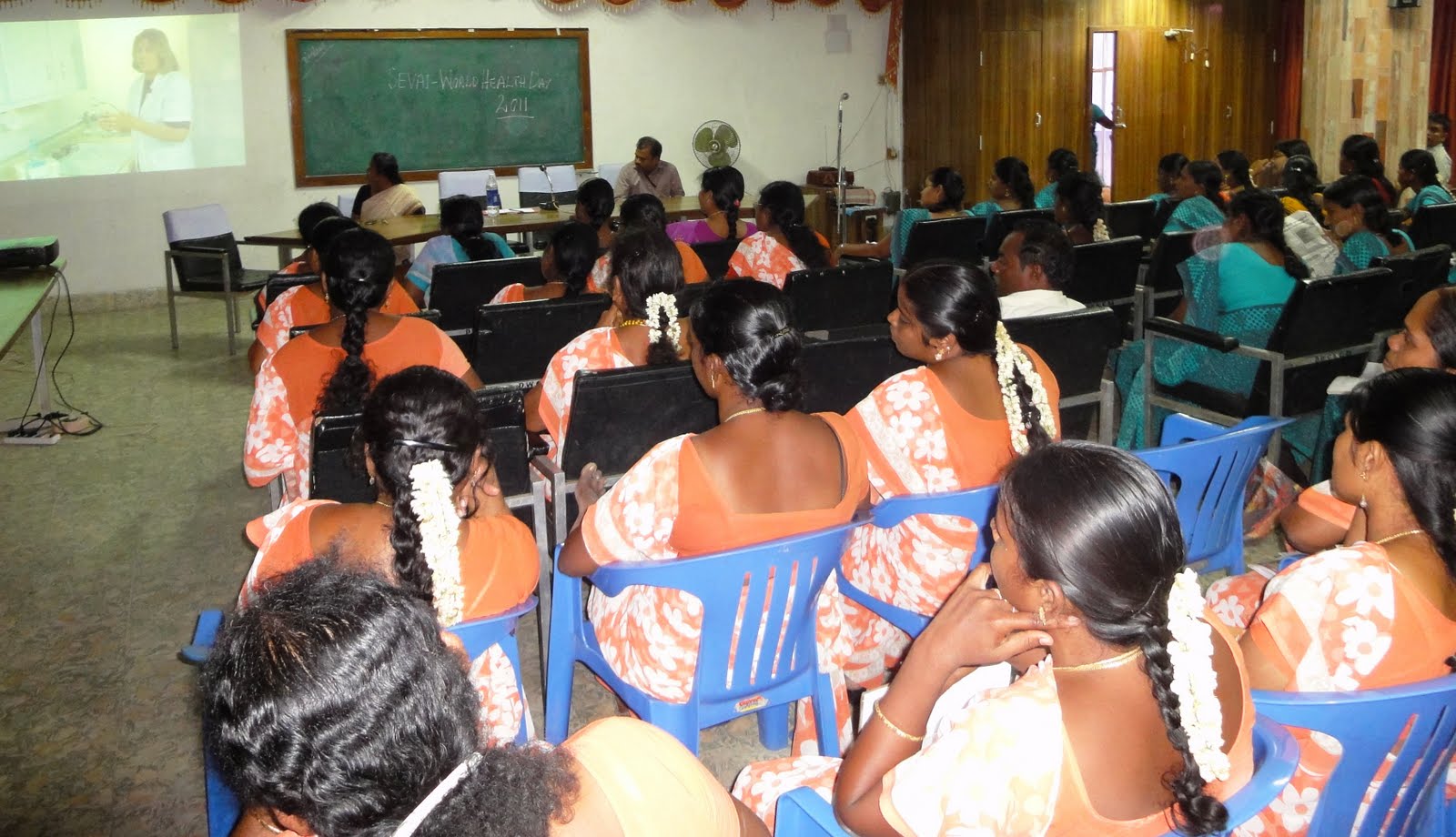
It was decided to impart training to volunteers in the village level on positive health and awareness on HIV/AIDS prevention and also for rehabilitation of PLHIVS.Earlier Dr.Nazrin welcomed the gathering, Dr.Deivakumar proposed vote of thanks.-Govin
Thursday, April 7, 2011
Key aspects of affordable housing in Trichy slums-Self-reliance, low-cost, conservation, employment, sustainable life-style.

With this rapid urbanisation, one of the biggest challenges will be providing affordable housing to city slum dwellers, especially the poor. Housing is integral to the well-being of a family. Over a billion people around the world live in appalling conditions of urban slums lacking the benefits of adequate housing. In India alone, about 100 million persons live in slums and slum-like conditions without adequate basic facilities such as piped water, sanitation, schools, health, and so on. These numbers are expected to touch 200 million by 2020. In Trichy city of Tamilnadu around 20,000 families lack affordable housing in the slum areas and most of them are members of women self help groups. There are now and then fire and seasonal flood catastrophes affecting the slum dwellers. There is a need for adequate homes on serviced land spread across the Trichy City especially near employment centres where people can live at affordable costs rather than squatting on vacant lands. Such housing pockets could be developed by government and Non Governmental and corporate bodies. NGOs and other civil society organisations are to be involved in planning houses for the poor in terms of design and facilities.
 They can ensure the involvement of the urban poor in housing and resettlement efforts so that the plan is developed by those who have to be settled and relocated.NGOs can also play an important role in loan recovery by encouraging and facilitating slum Self Help Group Members communities to save part of their earnings in recurring deposits and by making SHG supports available to them. Facilitating such regular savings helps the more vulnerable families to benefit from such housing schemes. It is also important to look for new methods of land use planning and management factoring in the population growth projections. Housing the poor is an urgent and important need for building socially inclusive communities offering equity of life for all. What we need is accurate planning and mainstreaming of the urban poor in the economic growth story of our urban areas. The situation gets aggravated with every passing year as the demand for affordable housing grows with increase in population and there are limits to the extent to which the society can mobilise funds for its citizens. SEVAI, a Trichy based NGO has undertaken affordable housing with cost effective approach for slum dwellers of Trichy city whose homes had been affected by fire and also floods. The houses had been constructed at the house site owned and authorized by City Corporation.


A major constraint in meeting this demand is the spiralling cost of land and other building materials. The answer to the rising cost of building materials is to use cost-effective building technology. The results of the use of cost-effective technology is logical and as per proven adoption of technology for intended purpose. Buildings using this technology have been constructed at costs much below the projections and without compromising strength, durability, safety or aesthetics. SEVAI Rural housing energy efficient housing technology has been applied in the construction of around 100 homes at a span of 45 days in K.Abisekapuram Division of Trichy. Cost-effective technology had been adopted and this cost effective housing is a collection of strategies that use innovative materials and /or techniques without compromising the structural and functional requirements and produce a holistic design to construct buildings at a cost far less than what it would take normally. The main aim of such technologies is to introduce savings without compromising on the strength, durability, comfort and elegance. It should be clearly understood that these technologies are not low-cost or cheap at the expense of quality. Hollow Block wall practice has been applied such a way that strength is equal to standard 9" (229mm) brick wall, but consumes 20% less building material. The air medium that is created by the bond helps maintaining a good thermal comfort inside the building. As the construction is appealing to the eye from both internally & externally, plastering is not necessary.
The overall saving on cost of this wall compared to the traditional 9" wall is about 26%. Newer and better kind of foundations have been developed which are reasonable and less-time consuming. Using arch foundations, pile foundation or column foundation can bring down costs by 40 per cent, 25 per cent and 18 per cent respectively, over the normal open foundations. Similarly, the cost of two RCC door frames is Rs 320 while that of teak wood would be around Rs 1,500. Substituting steel or concrete cement frames for wood would save a whopping 60-70 per cent on cost! Reducing the usage of large amounts of steel through LCH+ technologies saves about 70 per cent of the cost. This technology has about 30% overall-saving on cost of a building of traditional 9" construction. However, SEVAI strongly believed that these designs were considered only as a guide and decision-making on the type of house needed by occupants was a consultative process prior to construction. Self-reliance, low-cost, conservation, employment, sustainable life-style are some of the aspects of economy in housing of SEVAI implemented in Trichy Slums. The government may have noble intentions of giving the poor a good industrial and urban roofing material. But it is important to use the locally produced materials for the housing for foundation, walls, roofs, windows and doors etc.-Govin
Sunday, April 3, 2011
‘It is easier to transport knowledge to underprivileged than to transport underprivileged to the people of knowledge’ -thanks to Distance and continuing Education of Manonmaniam Sundaranar University

Trichy 3, April: ‘‘It is easier to transport knowledge to underprivileged than to transport underprivileged to the people of knowledge’ -thanks to Distance and continuing Education of Manonmaniam Sundaranar University Mrs.P.Chitra, Secretary, South Zone Board of Continuing Education in a seminar orgnised by SICE, Trichy here on Sunday on ‘Distance and Continuing Education’. SICE (Sevai Institute of Continuing Education) functions as one of the study centre of Directorate of Distance and Continuing Education of Manonmaniam Sundaranar University Tirunelveli, Tamil Nadu.The students of Manonmaniam Sundaranar University Tirunelveli enrolled under distance Education mode by the University authorized centre G-36-SICE, Trichy centre mostly members of the Self help groups or their members of the families OF Trichirappalli District.Mrs.P.Chitra appreciated ‘Manonmaniam Sundaranar University for taking Higher Education to the door steps of women self Help Groups under their Distance Education mode as Women form the pivotal point around whom family life and living revolves’. Mrs.P.Chitra added ‘Development is a process of structural change in the economic, political, social and cultural domains. It starts with people as they are the primary and ultimate focus of all development. It empowers women through Distance Learning, historically explores the causes and reasons for long denial of formal education to women. Distance Education has emerged as a boon to women of all ages to equip themselves intellectually through acquisition of knowledge, leading them to new radical methods of thinking, and alternative, lateral perspectives on existing information thus rendering them more autonomous and liberated. It enhances the aspirants personal and professional competence-to Self Help Women who wish to profitably use their time and resources to satisfy their deferred academic aspirations- who have no access to the mainline educational system and it is committed to provide access to affordable, supportive and flexible but quality education to all women seekers of knowledge from all walks of life. Women empowerment is a global issue. Empowerment is an active multi-dimensional process which enables women to realize their full identity and powers in all spheres of life. The special characteristic of this Distance and continuing Education is that it is endowed with high flexibility and can meet the demands of education for all and `continuing education' which the conventional education system is unable to meet. Further, distance education takes education to places and people hitherto unreached, transcending social, economic and geographical equality and thereby opens a new vista in our striving towards breaking the barriers of `opportunity and equity'. Through distance education it is easier to transport knowledge to people than transport people to the people of knowledge. Women as a category could really take advantage of the provision of distance education in a large measure’. The barriers for the low percentage of enrollment of women in higher education, there are two distinct aspects to women's participation in higher education. One is access and the other is continuation. There are several socio-economic-cultural factors which hinder women's enrollment in higher education. The attitude of parents, especially the uneducated and very conservative parents is such that they do not see any value or necessity for educating girls. In fact, there is resistance and hesitation for investment in girls' education as the parents do not expect to get returns from this. Parents also hesitate to send girls to colleges, if no exclusive women's college is available in their vicinity. The Self Help Group movement gives courage to women to aspire for higher education and it is good that Manonmaniam Sundaranar University reaches the remotest villages under their distance education mode’ and the SHGs and Study centres should come up to the highest level of gaining knowing through higher education under distance and continuing Education mode.’Govin
Please visit:
Please visit:
http://www.youtube.com/watch?v=4QQhRJrJ7oE
"VOICES FOR AUTISM" SHORT FILM PROJECTED ON WORLD AUTISM AWARENESS DAY, APRIL 2, 2011

Trichy: SEVAI observe the fourth AUTISM AWARENESS DAY on 2nd, April 2011 at SYSTEM Centre, DWC complex in Trichy. On this occasion, a documentary film titled “VOICES FOR AUTISM" had been projected enlightening the participants regarding AUTISM AWARENESS DAY.Dr.Deivakumar, Coordinator of SEVAI project mentioned that ‘On December 18, 2007, the United Nations General Assembly adopted resolution which declares April 2 as World Autism Awareness Day (WAAD) in perpetuity. This UN resolution is one of only three official disease-specific United Nations Days and will bring the world's attention to autism, a pervasive disorder that affects tens of millions. The World Autism Awareness Day resolution encourages all Member States to take measures to raise awareness about autism throughout society and to encourage early diagnosis and early intervention. It further expresses deep concern at the prevalence and high rate of autism in children in all regions of the world and the consequent developmental challenges. World Autism Awareness Day shines a bright light on autism as a growing global health crisis. WAAD activities help to increase and develop world knowledge of the autism epidemic and impart information regarding the importance of early diagnosis and early intervention. Additionally, WAAD celebrates the unique talents and skills of persons with autism and is a day when individuals with autism are warmly welcomed and embraced in community events around the globe. A voice to the millions of individuals worldwide who are undiagnosed, misunderstood and looking for help should be supported to inspire compassion, inclusion and hope.
Special Educator Diana mentioned that ‘Education is imperative and has been denied to the Autism community for far too long. "Rapid Prompting Method “is a key that has "unlocked" the potential for hundreds of individuals and offers a new way of teaching academics particularly for non verbal children with autism. Doctors and scientists still consider the disorder of autism to be a bit of a mystery. For example, compared to other medical disorders, knowledge is quite thin when it comes to the root causes of autism, better treatment for those with the condition, how much (or how little) the environment plays a role in causing the condition, etc.’
The awareness rally started from SYSTEM Centre and Mrs. Percy Lal flagged off the rally of those work for creating awareness on Autism Awareness and reached the DWC Conference hall.Mrs.P.Chitra project Director SEVAI presided over the function. The guest of honour Mrs.Percy,DRP of Trichy District for Link Workers scheme of APAC and NAACCO said ‘Unlike other disorders that medical experts better understand the cause and treatment for, autism is still very much considered something that we need much more information about. Over the last few decades, it has been reported that the number of children diagnosed with autism has been increasing. Upon hearing this fact, some people take this to mean that the number of people with autism has increased. However, this is not necessarily the case. The fact that more people have been diagnosed with autism does not necessarily mean that a higher percentage of people actually have autism these days’. There are a number of possible explanations to account for the apparent rise of autism diagnoses’.
Dr.Susitra said ‘Here are two such possible explanations: The increase in diagnoses is credited to breakthroughs in research and a better understanding of autism. This better understanding of autism has lead medical experts to develop more nuanced systems of categorizing the condition. Essentially, then, the definition of what counts and what does not count as autism has changed slightly over the last few decades. Because of this, some individuals who might not have been diagnosed as autistic 30 years ago might now find themselves diagnosed as such. Additionally, another frequently offered explanation explaining why we see an increase in the diagnosis of autism in children involves our better access to medical care and information. With each passing decade, people generally have better access to medical care. The medical care itself also improves. Due to these improvements, people who might have been autistic (but never were able to have it properly diagnosed due to lack of access to qualified medical physicians) now find themselves with better access to medical care and can receive proper diagnoses. And so, as the argument would proceed, because the number of people going to doctors increases, even if the percentage of people who have autism remains constant, the number of people diagnosed with autism will necessarily increase as well. Progress has been made in regards to the general public understanding Autism. A number of films have been produced, aimed to offer a first-hand look into the disorder, and the day-to-day dealings of families affected by it. Parents play a critical role in all behavioral interventions for children with autism. The day is observed in the best interest of children with autism for their parents to know the contours of the science of applied behavior analysis so that their children can make all possible progress, teaching procedures that help children with autism learn to engage in the give and take of ordinary, daily conversation with parents, teachers, and peers. EtNS.vide you tube
http://www.youtube.com/watch?v=dTr3HG32loM
Subscribe to:
Posts (Atom)